Honours
Define awards in the catalogue, set the rules and see in the preview who will be honoured when.
Honours are occasions, not paperwork: 25 years in the band, 40 years on the flugelhorn, ten years as treasurer. SinfoniaOne answers the question that otherwise gets answered from memory just before the annual general meeting — who is due?
Two things belong together here:
- The catalogue — which awards your band gives out, and after how many years.
- The preview — who can be honoured in the coming years, sorted by year.
The catalogue is usually filled already
If your band is based in Austria, SinfoniaOne fills the catalogue for you when the band is created — with the honours of your regional wind music association and those of the Austrian Wind Music Association. A band in Lower Austria will find the NÖBV medals of merit with their thresholds (15, 25, 40 years), the additional clasps, the sutler badges and the supporter pins.
Which association that is depends on the federal state in your band's master data. It is derived from the postcode when the band is created — and you can change it at any time.
Postcodes get it wrong at the edges
The suggestion from the postcode is convenient but not always right: East Tyrol has Carinthian postcodes, Tyrol and Vorarlberg share the 6xxx range, and Kittsee and the Jennersdorf district belong to Burgenland while sitting in the middle of other ranges. Check the federal state once after founding the band.
The defaults are suggestions, not rules. You may rename any entry, change its threshold, deactivate it or delete it — no entry is protected.
Not every default has a threshold
Many association honours do not depend on a number of years alone, but additionally on a judgement (“outstanding service”) or are graded by office (“10 years as chairperson, 15 years for other officers”). Such entries deliberately come without a rule — the conditions are in the description, and you add the threshold yourself if you want to define one for your band. Better an empty line than an invitation to an honour someone is not entitled to.
Anyone who already has a catalogue keeps it
Bands that had already recorded their own awards get nothing added — otherwise two entries for the same thing would sit side by side. And bands outside Austria get no defaults; they set up their catalogue as described below.
Setting up the catalogue
You will find the list in the menu under Configuration › Members › Honours. Every award your band gives out gets an entry here.
Create a new award
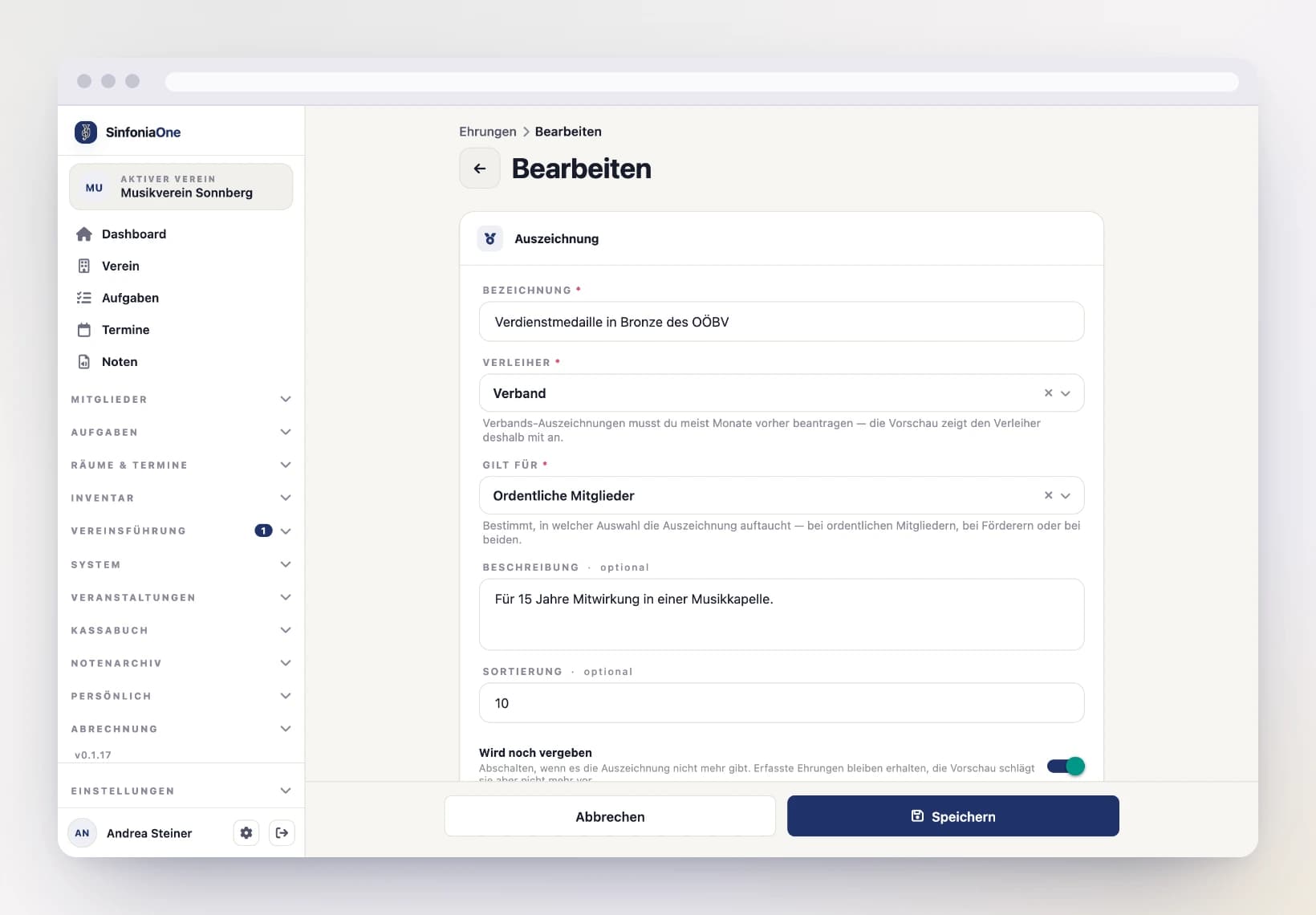
Tap “New award” and enter the name, for example “Gold badge of honour”.
Choose who confers it
State who awards it: band, district or association. This is not a formality — an association award usually has to be applied for months in advance, whereas a band badge is in the drawer. That is why the preview shows the conferrer on every line.
Choose the audience
Under “Applies to” you define who the award is meant for: ordinary members, supporting members or both. This determines which picker it later appears in — the supporter pin will not show up for musicians, and the medal for 40 years of playing will not show up for supporters.
Set the order
The sort order determines the sequence in which awards appear. Bronze 10, silver 20, gold 30 works well — that leaves room for intermediate levels.

Usable without a rule
An award without a rule is allowed — for example, recognition for a special contribution. You can record it as usual; it simply does not appear in the preview, because no date can be calculated for it.
Rules: when an honour becomes due
A rule consists of an occasion, a threshold and, optionally, a repetition.
| Occasion | Calculated from | Typical for |
|---|---|---|
| Years of membership | the membership periods | “25 years in the band” |
| Years in office | the assigned functions | “10 years as treasurer” |
| Age | the year of birth | “for the 70th birthday” |
The repetition saves you several entries: “from 25 years, then every 10 years” produces 25, 35, 45 — one rule instead of three.
An award may have several rules. “Gold badge from 40 years of membership or from 25 years on the board” is two rules on one entry.
Years in office in detail
If you pick a specific function for an office rule, only the years in that office count. If you leave the field empty, years in any function count.
Sub-functions count towards the parent
Years in a sub-function count towards the parent office: someone who was “sheet music archivist” for 15 years has 15 years as “archivist” behind them. The reverse does not apply — a general archivist was never specifically the sheet music archivist.
Two offices at once are one term of service
Someone who was treasurer and board member at the same time for ten years has ten years in office — not twenty. What counts is the period, not the number of offices.
How the calculation works — and why breaks matter
The years do not come from “today minus year of entry”. They are calculated from the membership periods, and with interruptions that makes all the difference:
Anna has been a member continuously since 2000. Bert also joined in 2000, but took a break from 2013 to 2015.
In 2025 Anna has completed 25 years and is honoured. Bert has 23 years — he is due in 2027.
That is intentional: an honour for 25 years should stand for 25 years.
Without membership periods the year of entry is used
If you have recorded no membership period for a member, SinfoniaOne uses the year of entry from the registry — so without any interruptions. As soon as you record even one period, that period takes precedence. If you want breaks and re-joinings reflected correctly, maintain them under membership periods in the member detail view.
For the age occasion only the year of birth counts, not the exact day — someone with a December birthday is on the list from January. For planning an annual general meeting that is the right resolution. If the date of birth is missing, the rule simply does not apply to that member.
Using the preview
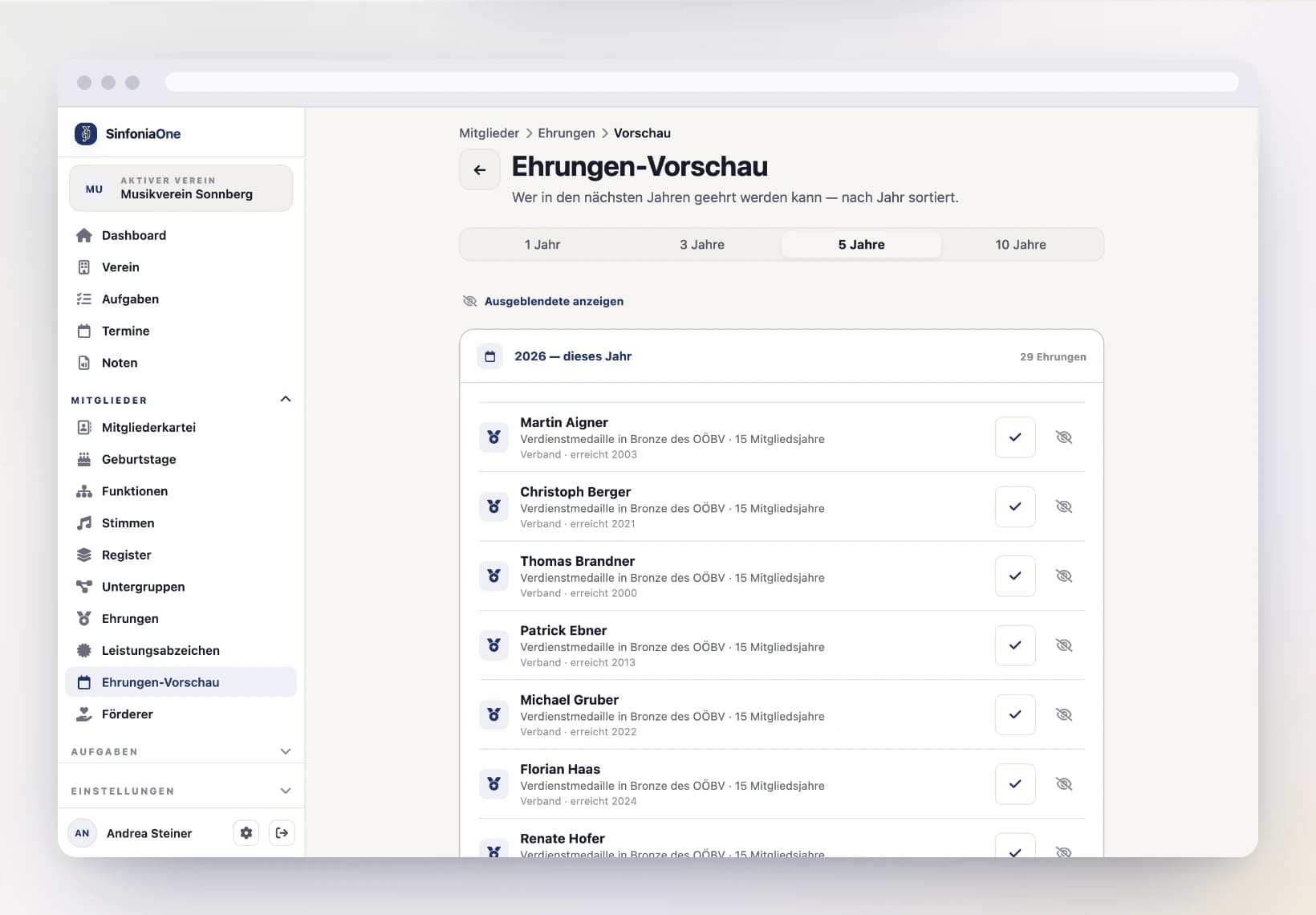
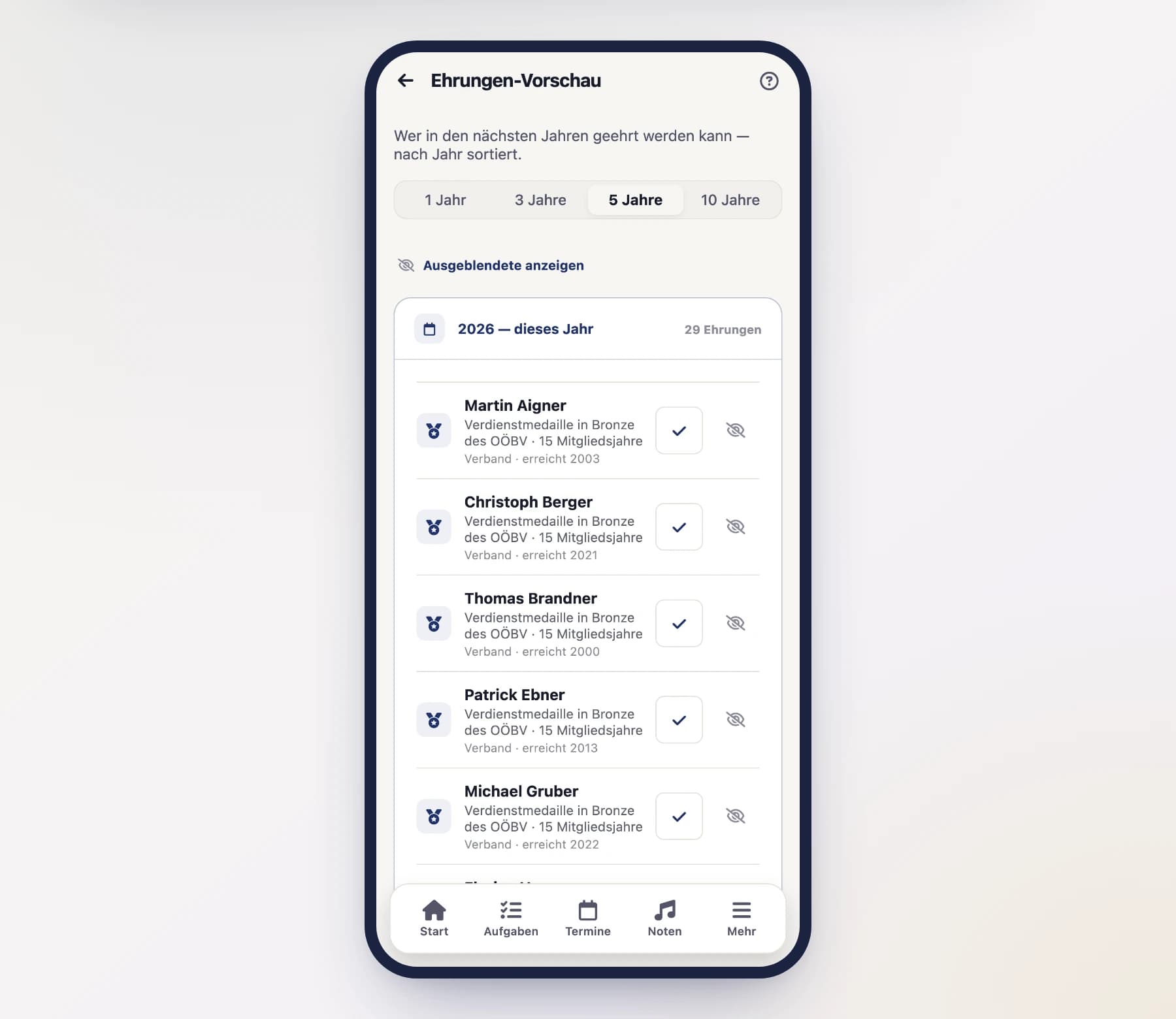
You reach the honours preview from the menu or via the “Preview” button in the honours list. It shows the coming years as separate blocks, with the current year at the top.
Use the switcher at the top to choose the range: 1, 3, 5 or 10 years. Five years covers any annual general meeting planning.
Each line gives the name, the award, the occasion and the conferrer. Tapping the name takes you to the member.
Years without honours stay visible
A year with no entries does not disappear — it shows “No honours”. That way you can see at a glance that nothing was forgotten; “there is nothing” is just as useful an answer as a list.
Recording an honour
Once an honour has actually been conferred, record it with the member — then it disappears from the preview.
From the preview
In the preview, tap the check mark at the right of the line. The form opens with the award and the threshold already filled in.
Or in the member detail view
Open the member and tap “New” in the “Honours & badges” section.
Performance badges live elsewhere
Junior, Bronze, Silver and Gold do not belong in this section — they have their own: Performance badges. An honour is reached, a performance badge is taken — which is why they are two lists.
Fill in and save
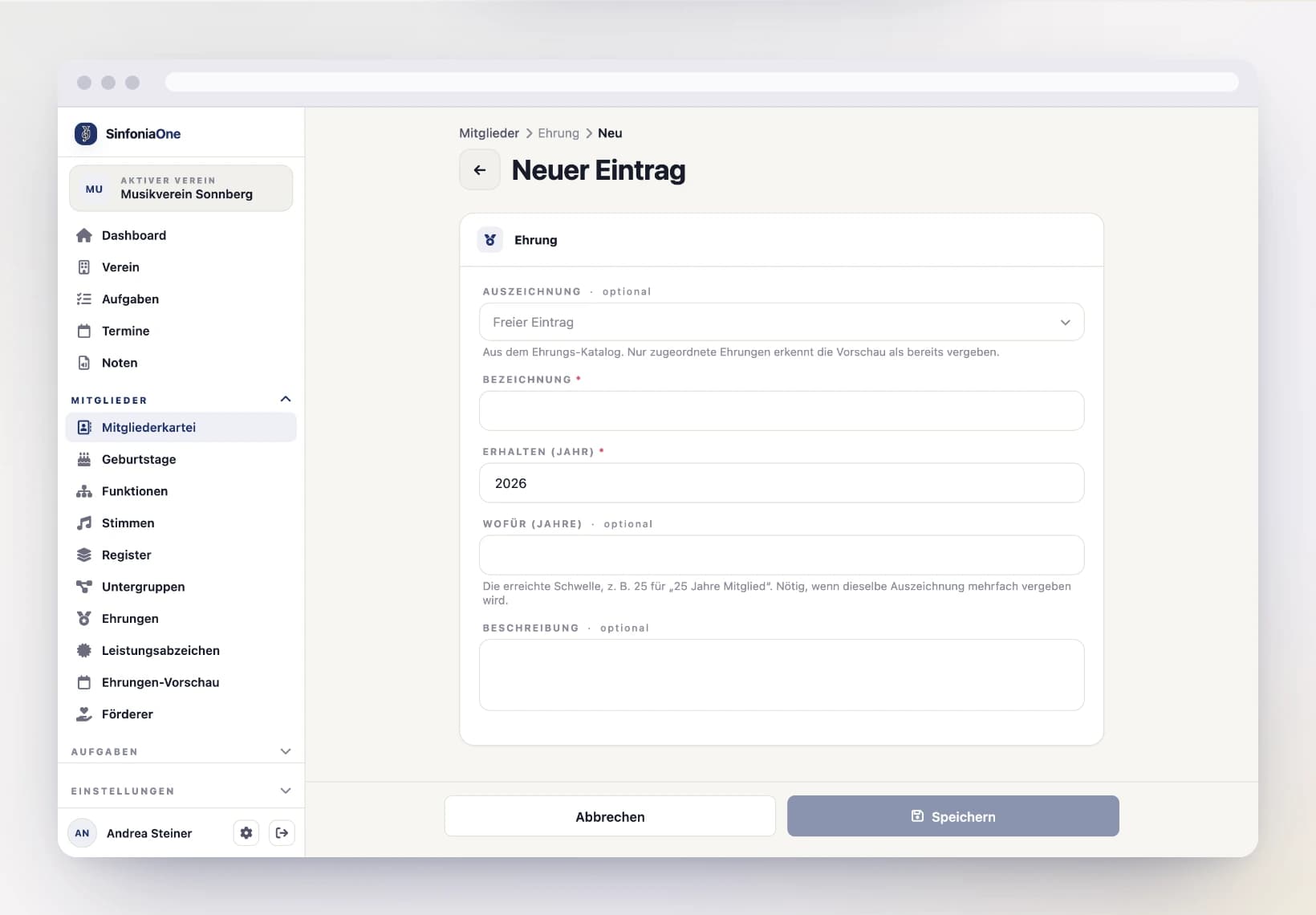
Choose the award from the catalogue, enter the year and — for repeatable honours — the threshold reached under “For (years)”.
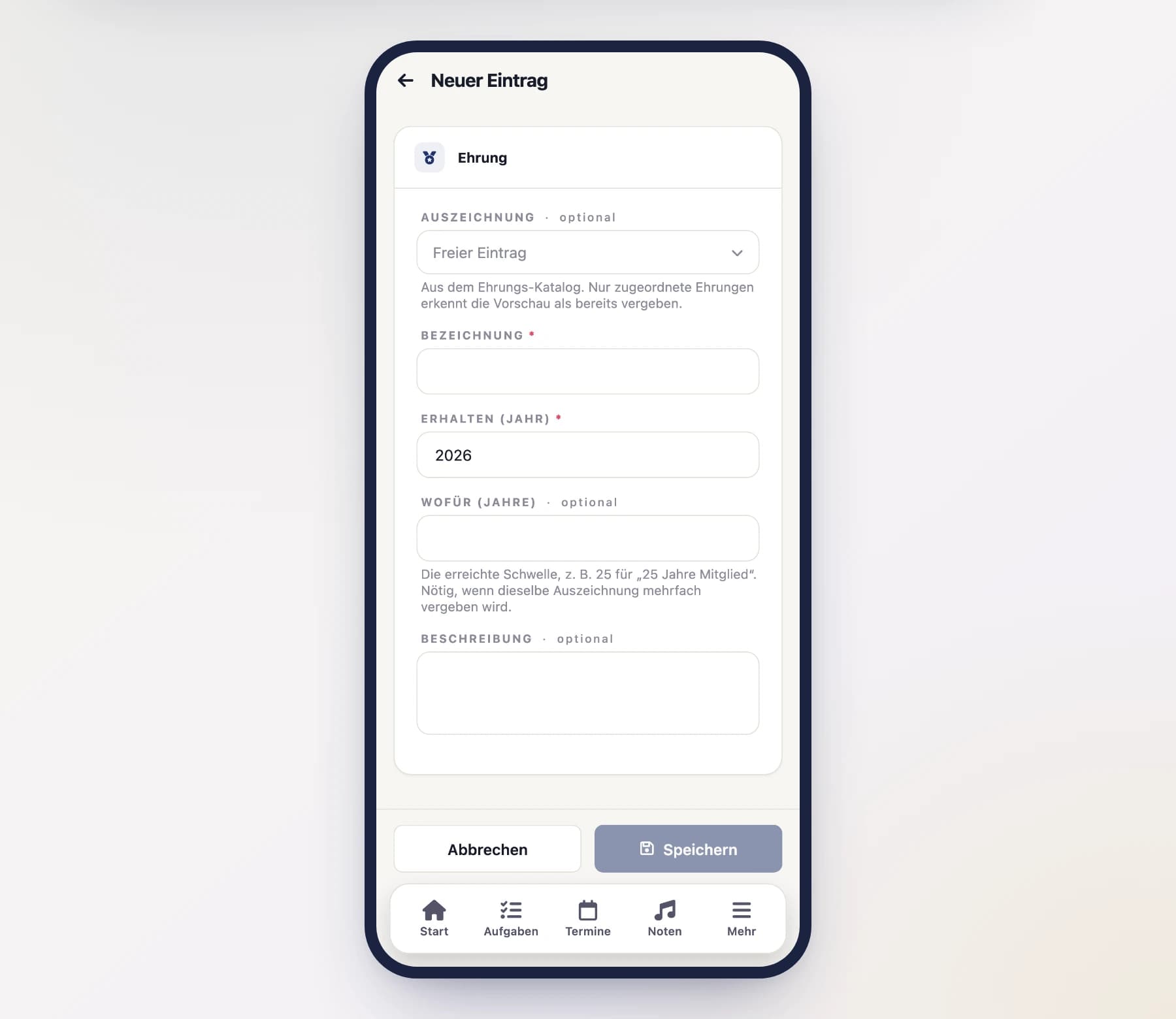
Assign old entries to the catalogue
Honours you recorded as free text before creating the catalogue are only recognised by the preview if the name matches exactly (upper and lower case do not matter). So name the catalogue entry the way you have been writing the honour — or assign the old entries afterwards. Otherwise the preview will suggest an honour that was conferred long ago.
When a level was never conferred
Not every threshold reached ends with a certificate. Somebody who received the silver badge but never the bronze one — because it did not exist back then, because the band skipped a level, or because the years come from another band — would otherwise have the bronze one sitting in the preview forever: reached, never recorded.
That is what hiding is for. In the preview, tap the crossed-out eye at the right of the line. After a confirmation the line disappears from the preview — and from the annual reminder.
Hidden does not mean conferred
A hidden entry records nothing among the member's honours. The chronicle still only lists what was actually conferred. So never invent an honour just to quieten a list — hiding is there for that.
Hiding always applies to exactly one level: this person, this award, this number of years. With a repeating rule (“from 25 years, then every 10”) the later levels remain — hide the outdated 25 and the person is back on the list at 35.
Showing them again
Above the year switcher in the preview you will find “Show hidden”. Hidden lines then appear faded and marked “Hidden”; the eye on the right brings them back into the preview.
Who may hide an entry?
The same permission as for recording: whoever may enter an honour may also decide that none is coming. Showing an entry again requires the permission to delete honours.
Reminder about upcoming honours
Once a year SinfoniaOne reports on its own which honours are due in the current year. The message goes to the secretary and the chairperson — the offices that order and confer awards. If nobody holds these functions, it goes to everyone allowed to maintain the member registry.
The reminder arrives once a year, not weekly: an honour is an occasion, not a demand.
Only with a catalogue
Without awards and rules, SinfoniaOne sends no reminder. If you do not use the feature, you will not hear from it.
Honours for supporting members
You can record honours for supporting members as well — choosing from the catalogue just the same. Only entries whose “Applies to” is set to supporting members or both are offered there.
They do not appear in the preview, however: supporting members have no membership periods and no functions from which a due date could be calculated. Their honours therefore remain pure chronicle entries.
The associations draw the line differently
Some honours are explicitly meant for both — the NÖBV band hall service badge counts volunteer hours and does not ask whether someone plays. Others explicitly exclude the band's own musicians, such as the NÖBV supporter pin. The defaults already reflect this; for your own entries you decide.
Who is allowed to do what?
- Maintaining the catalogue (creating, editing and deleting awards and rules) is open by default to administrators and the secretary. If the board should be able to do it too, give its role the permissions for “award type” and “award rule”.
- Seeing the preview is open to anyone allowed to see honours. It derives due dates partly from years of birth and is therefore not visible to every member.
- Recording honours is open to anyone who maintains the member registry.
- Hiding an entry is open to anyone who may record honours — it is the same decision with the other outcome. Showing it again requires the permission to delete honours.
More on this under Roles & permissions.